


Showing posts with label leica oskar barnack award. Show all posts
Showing posts with label leica oskar barnack award. Show all posts
Saturday, 3 April 2010

Friday, 19 March 2010
The Road to Nowhere - Dominic Nahr


It is estimated that the mineral reserves that lie in the subsoil of the Democratic Republic of Congo (DRC) have a value in excess of 24 trillion USD. This is a sum greater than the combined GDP of both the United States and the 27 European Union (EU) countries. This is also an estimate that does not include the vast timber reserves of the Congo River Basin, which is the second largest rainforest after the Amazon; nor does it include the vast potential for fresh water supply or for hydroelectric to harness the power of its vast rivers. Its unique biodiversity of flora and fauna presents pharmaceutical companies with a plethora of ingredients for use in pharmaceutical base products. Congo’s fertile landscape also gives it great potential to become the breadbasket of central Africa.
.
However, while its ‘abundant natural wealth makes it potentially one the richest nations on earth, its gross domestic product per head is among the lowest in the world’. In fact, if you divide the World Bank’s GDP (purchasing power parity - PPP) data for DR Congo by the World Bank’s population estimate (64, 205000) you get a figure of 328 PPP USD, which ranks it last in the world. Most Congolese have slid further into poverty and in 2000 is was estimated that ‘per capita income was 25 percent of 1970 levels’. In North Kivu, a region along the Ugandan and Rwandan border and one of the most violent regions of the civil war, the average income per day is just 0.16 USD.
Civil war has plagued the DRC for over a decade. The situation in DR Congo has lead it to be termed the African World War, The Great African War and the Scramble for Africa. Foreign state involvement and their strategic economic interest in Congo bears striking similarities to European colonial powers scramble to carve up the continent in the late nineteenth century. It is a conflict that has involved six African nations and more than a dozen rebel groups. Estimates of the number of mortalities from the beginning of the second conflict in 1998 range from 3.9 million to 5.4 million (International Rescue Committee, 2008). Most of these deaths are either a direct or indirect consequence of hostilities. In the latest estimate, it is thought that around ‘727,000 people died in excess of normal mortality’ rates (International Rescue Committee). It is further estimated that around 45,000 people continue to die every month, remaining at a pace comparable to the hostilities of 1998-2004. DR Congo’s mortality rate is 60% higher than sub-Saharan Africa’s average. Causes of death that can be indirectly attributed to the war include poverty; malnutrition and severe food insecurity and disease. In fact, DR Congo has the lowest healthcare expenditure of any country in the world, with an average of just $15 per person per year (International Rescue Committee).
The World Food Programme find the food security situation in DR Congo ‘extremely alarming’ and the International Food Policy Research Institute rank it last in the world on the Global Hunger Index (GHI). In 1990, the GHI rating for DR Congo was 25.5; two of its neighbours, Congo-Brazzaville and Uganda were rated at 21.0 and 18.7 respectively where a higher index score represents worse performance. In 2009, DR Congo was rated at 39.1 and Congo-Brazzaville and Uganda were rated 15.4 and 14.8 respectively.
Conflict has made the food security situation worse. Civil war in DR Congo has made it the deadliest war since the Second World War.
Dominic Nahr won the Leica Oskar Barnack Newcomer Award in 2009 for The Road to Nowhere
Wednesday, 17 March 2010
Guano - Tomas Munita


 ©
The recent surge in synthetic fertilizer prices and the demand for organic food in the West has resurrected the old 19th Century practice of guano harvesting on two small Peruvian islands. The Peruvian government only allows harvesting to take place on two islands, but guano can be found on around twenty. The islands collect the droppings of swarms of seabirds - their exceptionally dry climate preserves them and allows them to accumulate in vast quantities. In the 19th Century it is estimated that guano deposits reached heights of around 150ft. Guano export and production boomed in this period and it is thought that it accounted for 50% of the Peruvian government’s national budget.
Guano has had somewhat of a resurgence with the growth in organic food production and the demand for natural fertiliser. Guano sells in Peru for $250 per ton; in France, Israel and the United States it reaches $500 per ton. There is therefore a big incentive to export guano to the metropoles of the North where a higher price is sought. This is of course to the detriment of local Peruvian farmers where it is was once a primary and cheap source of fertiliser. 'While guano is less efficient than urea at releasing nitrates into the soil, its status as an organic fertilizer has increased demand, transforming it into a niche fertilizer sought around the world' (New York Times).
This is not the only pressure on price however. The presence of the anchoveta, a fish which is the birds’ main source of food is fished in increasingly large quantities – its end point is use as feed for poultry and other livestock in Asia where consumption has soared. A burgeoning middle class has created a growing demand for meat and other commodities associated with moving up the 'development ladder'. This was of course partly a cause of the World Food Crisis, where increased meat consumption in Asia lead to the need for ever greater grain inputs to feed livestock. Naturally, with increased demand for grain production this also increased the price of nitrous fertilisers. With the drive for cheaper inputs, the anchoveta fish became a cost-effective way of feeding livestock. Fishing of the anchoveta fish has placed pressure on the Peruvian seabirds' population where the fish is its main source of sustenance. Guano deposits are therefore set to decrease. The Peruvian government has already stepped in and halted all production on all except two islands. It is not only depleted anchoveta stocks that place pressure on the birds, but also the loud noise of boat engines that scare them afar. The Peruvian guano harvesters have therefore taken to patrolling the waters surrounding the islands to ward off fishermen.
Increased guano harvesting and decreasing guano levels have lead to an increase in its price. This is simple supply and demand. There is not enough guano to meet demand. As Peruvian mango farmer Enrique Balmaceda notes, with 'organic bananas competing for what’s available', prices for guano are also set to increase.
With a resurge in demand for guano, it is thought there are enough deposits for the next ten to twenty years.
.
Guano workers make the pilgrimage on boats to islands such as Isla de Asia (the location of Munta's photo-series) where they receive around $600 per month, three-times the amount they would earn through agricultural labour in the impoverished Pervuvian highlands.
'Many go barefoot, their feet and lower legs coated with guano by the time their shifts end in the early afternoon. Some wear handkerchiefs over their mouths and nostrils to avoid breathing in guano dust, which, fortunately, is almost odorless aside from a faint smell of ammonia.' (New York Times)
Tomas Munita’s photo-series for the New York Times provides a narrative of what essentially represents the globalization of commodity production, relations and the growing complexity and interelatedness of supply and demand.
The original New York Times article can be found here -
http://www.nytimes.com/2008/05/30/world/americas/30peru.html?pagewanted=1&_r=1
Tomas Munita -
http://www.tomasmunita.com/
Wednesday, 3 March 2010
Next to the National - Tom Muddimer


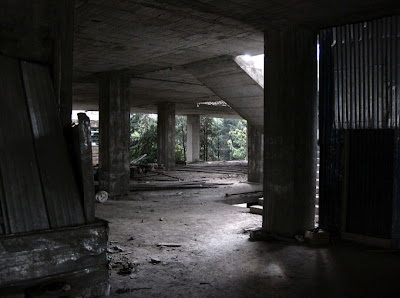
 © Tom Muddimer
'Next to The National' is a narrative on the stalled dreams of catch-up development - a series which documents just one of the many unfinished construction sites which have become typical in the urban centres of post-colonial Africa. Walk down Menelik II Avenue in Addis Ababa, and amongst the National Palace, the African Union and the National Hotel you will find a construction site – marked by tall, grey pillars. They stretch ambitiously skyward. Emperor Menelik II, was the famous guardian of national independence, founder of Ethiopia's capital and visionary of a modern, independent African state. Next to the National, carries forth his legacy.
Subscribe to:
Posts (Atom)